Announcing our new creative arts partnership with Odd Arts
Richard Kirkham, Principal Investigator, SALIENT Programme
On Friday 3rd July, I found myself in the company of some inspiring people at the Aquarius Centre in Hulme, Manchester, by invitation of Rebecca Friel MBE, the Chief Executive of Odd Arts. I first met Rebecca earlier in the year, on the advice of SALIENT’s Connie Smith who was aware of Rebecca’s work and suggested that I might be interested in finding out more.
The ‘vibe’ in Odd Arts HQ is positively infectious; I cannot help but think that Rebecca’s indefatigable nature and strong moral compass are part of the reason why positivity defines everything that is happening in this space. From the outside, their building is typical of those requisitioned by local authorities on election day, but on the inside, it is the creative heartbeat of the diverse Manchester community that it serves.
Friday’s event was focused on ‘Wellbeing Your Way’ (WYW); a 12-week programme supporting young people and adults experiencing mental health challenges. Rebecca and her team showcased the Odd Arts approach to supporting mental health & wellbeing through a series of workshops that show how theatre-based work can help connect young people, community participants, funders, teachers and partners with policy makers and civic leaders to explore systemic issues affecting the health of young people.
The highlight of the event was the ‘livestream’ to a local school, featuring theatre pieces designed by a group of 24 pupils. The original intention was to have the students at the Aquarius Centre for a live performance, but unexpected events dictated overwise. Adamant that all was not lost, Rebecca’s colleagues showed incredible fortitude and deployed the school’s livestream capabilities at a moment’s notice, and just in time for the arrival of the local MP, Afzal Khan CBE, who joined Tracey Rawlins, the Deputy Leader of Manchester City Council who participated in the workshops.
At the end of the session, I listened to some of the guests share their own experiences of mental ill-health. One of the observations that resonated with me was “we don’t need another PowerPoint presentation – we need some action”. Suffice to say, there wasn’t a single PowerPoint in sight at the WYW event. Finding effective help was also discussed, particularly in relation to Child and Adolescent Mental Health Services (CAMHS). Listening to the participant, I found myself writing “help, not a hyperlink” into my notebook as she explained how important it was to have face-to-face conversations with clinical practitioners and support service providers in Manchester.
‘Wellbeing Your Way’ recently worked with 24 men from different cultures and backgrounds across Manchester, working in both prisons and probation. The team delivered creative sessions with the men, exploring barriers to feeling a sense of safety, belonging and community in our city whilst in turn building a better understanding and resilience of themselves and others.
Many of the barriers explored linked to much bigger societal challenges including housing, mental health and the criminal justice system. Specific challenges included: inconsistent and harmful prison recall; being released from prison into homelessness; lack of mental health support; lack of trauma-informed responses from services and individuals working in the system; structural bias relating to class and race; limited community alternatives to prison; and limited lived-experience representation within frontline roles, resulting in gaps in empathy and understanding. These systemic issues were then developed into a legislative theatre piece, which offered a powerful starting point for discussions about how systems can be redesigned to promote safety, fairness and effective support.
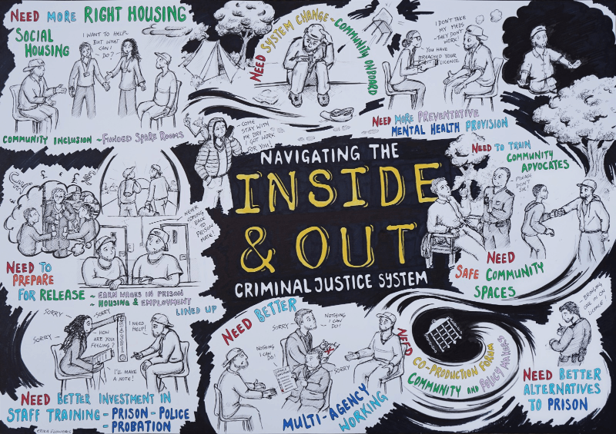
During Friday’s event, participants were encouraged to engage in discussion and debate through a variety of creative mediums, using some of the techniques that we are accustomed to in the ‘systems thinking’ community. For those who are familiar with the work of the late Professor Peter Checkland, you are likely to recognise the image below as a ‘rich picture’. Sadly, Prof Checkland passed away this year, but his legacy of the ‘Soft Systems Methodology’ lives on – notably in the UK Government’s guidance on ‘Systems Thinking for Civil Servants’, published by the Government Office for Science.
The ‘Navigating the Inside and Out Criminal Justice System’ picture was produced during one of the recent WYW sessions delivered by OddArts. It captures the essence of the challenges and the ‘whole-of-society’ response that is needed to tackle root causes of crime. But how did this ‘rich picture’ emerge? Emily (Senior Project Manager for Resettlement) and Jo (Senior Project Manager for Cohesion & Equality) tell the story….
“The work centred on character as a way of exploring emotional needs and relationships. Rather than starting with personal disclosure, the group created two fictional characters, a father and a son, and examined the conflict between them. By identifying each character’s unmet needs, participants explored how misunderstandings and tensions could be avoided or resolved. Many reflected that the story mirrored their own lives. This distancing through character allowed participants to reflect honestly without feeling exposed.
One of the most striking moments came from a young person who, on the first day, avoided eye contact and barely spoke. By the final session, they shared openly, made eye contact, expressed their opinions clearly, and took part in performance. This shift happened over just a few days and highlighted the power of creative approaches.
Given the varied levels of English in the room, the sessions relied heavily on non-verbal approaches. Mime, physical games, and embodied storytelling ensured everyone could participate fully. Importantly, role play and performance still proved effective. Participants were able to understand complex situations through action rather than language alone, demonstrating how theatre can bridge communication barriers where traditional discussion may struggle.
Odd Arts always strives to use theatre to look at both the systemic and personal challenges in people’s lives; when communicating in a more traditional way fails to address complex issues, theatre can be a meaningful and impactful way to do this.”
What next?
In July, SALIENT’s Operations Board approved funding to deliver a ‘cohesion event’
Returning to the ‘Rudd Review’ in my previous blog, it will be interesting to see if the terms of reference allow for a ‘human-centred systems approach’ to understanding the systemic issues alluded to in the Ministerial announcement. I cannot help but think that Ms Rudd and her team will be well served by a trip to Hulme in the very near future.