
With the hottest summer on record over [1] and news headlines turning from wildfires to how a ‘Godzilla’ El Niño might disrupt the UK’s future weather and food security [2], the social and ethical imperative to invest in societal resilience is compelling. Investing in societal resilience strengthens people, places, and organisations, so they can avoid disruptions through taking preventative action, enhancing their preparedness, responding safely together, and improving recovery.
Yet the financial argument for such investment has been difficult to make without a grounded evidence base to support the required strategic conversations. Putting a monetary value on investing in societal resilience offers a persuasive tool for advocates of a whole-of-society approach as a central ambition of government policy [3]. As we argued in an article for the MJ, local authorities as leading place-based actors, for example, can support communities to develop a self-help infrastructure ready for the disruptions ahead [4]. But such investment must be sustained multi-annually, with businesses and other organisations also playing their part to build a truly resilient society.
Our Social Return on Investment (SROI) analysis provides an urgently-required evidence base and demonstrates how a whole-of-society approach to resilience offers extraordinary value – ethically, socially, and financially.
Every £1 invested generates £35.12 of public value
Working with a range of partners in Cumbria (including Cumbria CVS) [1] over 18 months, our analysis shows that spending £1 on societal resilience will pay back 35 times over when disruptions hit every 5 years. This research was informed by a literature review which led to the selection of SROI and a working Theory of Change.
We then consulted 90 local people closely associated with disruptions (e.g. from affected households, communities, or organisations that plan for disruptions), leading to the identification and assessment of 74 measures for a monetarised model. Among these measures are 24 investments needed to strengthen societal resilience, and 50 savings (or avoided losses) from society being more resilient.
Savings and investments
Investments include household insurance, physical improvements to individuals’ homes, and activities and equipment for community volunteering related to disruption preparation (e.g. to support the coordination of a community resilience group). Savings include reduced impacts on domestic properties (e.g. less need for emergency rental accommodation for affected households), and avoiding paying the insurance excess on a claim.
Savings and investments are assessed separately for individuals, communities, Voluntary, Community, Faith, and Social Enterprise organisations (VCFSE), businesses, and central/local government. Not all benefits can be monetarised, of course – such as long-term well-being, community empowerment, and social cohesion – so there is extensive public value that remains unmeasured.
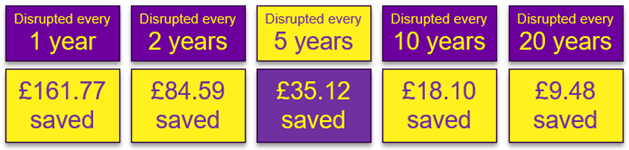
Our baseline result assumes one disruption happens every 5 years. The public value from investing £1 diminishes as disruptions become less frequent (as savings are less frequent), and increases as disruptions become more frequent (as savings are more frequent). The savings calculated for different ‘times between disruptions’ are shown in the graphic below.
Help communities to help themselves
Even modest central/local government investment can provide additional staff capacity to coordinate, guide, and facilitate society’s actions – not to deliver business-as-usual societal resilience activities. Without additional government capacity, the efforts of society would be far less effective and £35.12 would not be saved. However, investing £5,000 in community resilience groups brings £176,000 of public value through their work to encourage individual resilience practices and improve local resilience.
Resilience building actions that the government encourages and supports help to lessen the impact of a disruption, thereby reducing the need for state intervention to deliver services to those affected. Being resilient offers even more value to people and places that are at risk or vulnerable and lack the awareness of what to do, the financial means to do it, or the agency to act. Investment is essential.
- Download report: Assessing the public value of societal resilience to disruption
- Read academic paper: For every £1 spent on societal resilience to disruption in the UK, society benefits from £35.12 of public value
- Watch webinar recording: The public value of investing in societal resilience to disruption
Duncan Shaw is a Professor of Operations and Critical Systems at Alliance Manchester Business School and a SALIENT work package lead for Behavioural and Cultural Resilience.
Andrew McClelland is a Research Fellow at Alliance Manchester Business School and lead on a SALIENT-supported project starting in October 2026 (The role of charity shops in a whole of society approach to resilience to disruption).
References
[1] Met Office (2026). Summer 2026 provisionally hottest on record for the UK. Access: https://www.metoffice.gov.uk/about-us/news-and-media/media-centre/weather-and-climate-news/2026/summer-2026-provisionally-hottest-on-record-for-the-uk
[2] Burnett, N. (2026). What might a ‘Godzilla’ El Niño mean for the UK? House of Commons Library. Access: https://commonslibrary.parliament.uk/research-briefings/cbp-10901/
[3] Cabinet Office (2022). The UK Government Resilience Framework. Access: https://www.gov.uk/government/publications/the-uk-government-resilience-framework
[4] Shaw, D. and McClelland, A. (2026). Building resilient communities before the next crisis. The MJ. Access: https://www.themj.co.uk/building-resilient-communities-crisis
[5] This project was supported by DEFRA/Environment Agency, via the Cumbria Innovative Flood Resilience project, part of the £200m Flood and Coastal Innovation Programme (FCIP).